Demo 04 ·
TRACE
TRACE is a 30-second vertical demo where every frame is the soundtrack itself, plotted as an oscilloscope in XY mode plots it. Pure C, no assets. Full MP4.
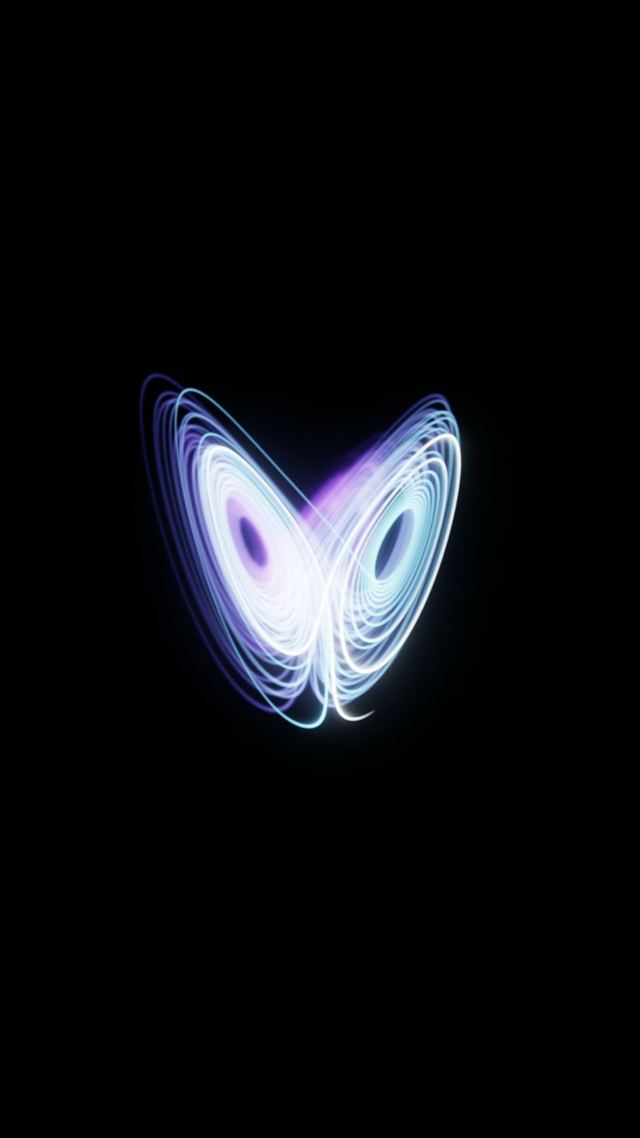
The full 1440×2560 render, never re-encoded.
- Length
- 0:30
- Frame
- 1440 × 2560 (9:16, vertical)
- Rate
- 60 fps
- Video
- H.264, High profile, 8-bit 4:2:0
- Audio
- AAC-LC, 48 kHz stereo
- Bitrate
- 24.9 Mbit/s average
- File
trace-1440x2560.mp4- Size
- 89.0 MiB (93,292,311 bytes)
- SHA-256
803e2f52f189a7ad7da7be8d79019baa69aa6cbe916b8a6e0a08d526711ad15a- Source
- fkkarakurt/demoscene/tree/main/demos/04-trace
- Licence
- MIT
TRACE is a thirty-second vertical demo in which nothing is drawn: every frame is the finished stereo soundtrack plotted the way an oscilloscope in XY mode plots it, left channel across and right channel up, with the last second and a half laid out in depth behind the present so that a camera can move around it. Composed for 1080×1920 and rendered at 1440×2560 and 60 frames per second, it runs at 120 BPM for 15 bars. Played into a real oscilloscope, its audio draws the same figures.
Every frame is computed from the finished, mastered soundtrack, the same buffer that is written
to the audio track, and from nothing else. A sample is a point: left channel x, right channel
y. The one thing added is a third axis. A sample of age a is placed at z = −a × speed, so
the present is a plane and the recent past lies behind it. Seen from in front, depth collapses
and what is left is the XY display; seen from the side, one channel collapses into depth and
what is left is the other channel against time, which is the oscilloscope’s other mode.
Silence, seen from in front, is the whole time axis stacked onto one point. That is why the film begins and ends on a dot, and why it loops.
StructurePermalink to “Structure”
| Bar | Time | Section | On screen |
|---|---|---|---|
| 0 | 0:00 | TUNE | A dot, then a circle. The harmonic series of A comes in a partial at a time, each sliding into tune, and the figure turns until the interval is pure and stops. |
| 2 | 0:04 | PULSE | The kick on the beat, which is a spiral, and the chord on the off-beat, which is a star. |
| 5 | 0:10 | CHAOS | The bass is the Lorenz system and the butterfly is its trajectory. |
| 8 | 0:16 | DROP | Everything at once, seen from the side: each kick a funnel on a tower of time. |
| 13 | 0:26 | NAME | A name traced by the beam fifty-five times a second and heard as a low A. Then silence, which is a dot. |
Sound as shapePermalink to “Sound as shape”
Every sound is also a shape, and the two are not related by a mapping: they are the same numbers. So the arrangement is written as much for the eye as for the ear.
- A pitch is how many times a second a shape is traced. A sine in both channels a quarter cycle apart is a circle, and it is the same circle at every pitch.
- A timbre is the shape itself. A closed path is a sum of rotating circles, its Fourier series, and each circle is one harmonic.
- A filter rounds corners off. The bass in the drop is a square traced at the root, and its filter envelope opens it from a circle into corners and closes it again on every note.
- Tuning is visible. Two voices in a small whole-number ratio trace a figure that closes and stands still; two that are not trace one that turns. So the piece is in just intonation over A = 55 Hz.
- A kick drum is a spiral: a sine falling from 190 Hz to 44 Hz in thirty milliseconds, whose radius is its envelope.
Two things follow that a normal mix never has to think about. Everything that sounds at once is drawn on top of itself, so instruments take turns. And there is no high-pass filter on the master: a filter is a phase shift, and a phase shift on a picture is a warp. Every instrument is built with no average offset instead, so there is nothing to take out.
The gain knobPermalink to “The gain knob”
The picture’s size and the music’s loudness are decoupled the way they are on a bench, by the volts-per-division knob: the mix is balanced by ear and the frame by eye.
| Section | Loudness | Display gain |
|---|---|---|
| TUNE | −13.2 LUFS | 1.80 |
| PULSE | −11.5 LUFS | 1.20 |
| CHAOS | −12.6 LUFS | 1.15 |
| DROP | −10.4 LUFS | 0.85 |
| NAME | −11.9 LUFS | 1.35 |
The whole piece is −11.5 LUFS integrated with a −1.0 dBFS peak. A figure lying along the other diagonal is two channels in opposite phase and cancels when summed to one speaker, so every section is measured folded down to mono: each comes out at −3 dB, the level of a circle, and none comes near silence.