Demo 05 ·
ENDURANCE
ENDURANCE is a two-minute 4K demo of Shackleton's ship, from the ice in 1915 to the wreck found 3,008 m down in 2022. Pure C, no assets, full 4K MP4.
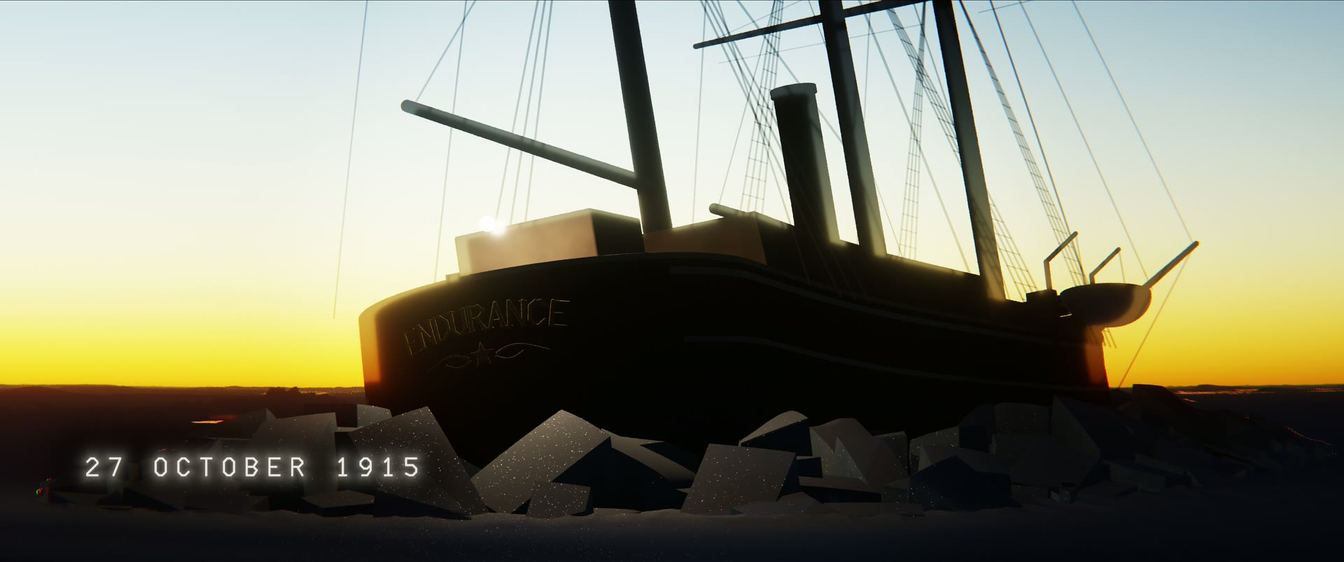
The full 3840×2160 render, never re-encoded.
- Length
- 2:00
- Frame
- 3840 × 2160 (16:9)
- Rate
- 24 fps
- Video
- H.264, High profile, 8-bit 4:2:0
- Audio
- AAC-LC, 48 kHz stereo
- Bitrate
- 23.2 Mbit/s average
- File
endurance-3840x2160.mp4- Size
- 331.5 MiB (347,646,676 bytes)
- SHA-256
bc2476b0c7f5381b008808a3a164e0eb8d8b4b0500e3e3f67b600c85db41c7bb- Source
- fkkarakurt/demoscene/tree/main/demos/05-endurance
- Licence
- MIT
ENDURANCE is a two-minute demo at 3840×2160 and 24 frames per second that tells a true story: Shackleton's ship frozen into the Weddell Sea in 1915, crushed and sunk that November, and found in March 2022 at a depth of 3,008 metres. The sun, moon and sky of every shot are computed for its real date, hour and position, and every frame is exposed through a model of a Super 35 film camera with a 180° shutter. Nothing in it is footage, an image file or a sample.
The picture is 2.39:1 inside the 16:9 frame, so the file carries black bars above and below it; that is the film’s framing, not letterboxing added afterwards. It is 60 BPM and 30 bars, exactly 120.000 seconds.
StructurePermalink to “Structure”
| Bar | Time | Act | On screen |
|---|---|---|---|
| 0 | 0:00 | WINTER | 22 June 1915, nine in the evening, 74° S. The ship held fast in the pack, lit by the moon, the stars and her own lamps. |
| 8 | 0:32 | PRESSURE | 27 October: the light at her stern until the ice cuts it. 28 October: the fore topmast, then the mainmast, come down. |
| 14 | 0:56 | SINKING | 21 November, just before five in the afternoon, a mile and a half away across the pack. Her stern rises, she dives, the ice closes. |
| 19 | 1:16 | DEEP | Following her down. The light goes red first, then green, then blue, and the gauge runs to 3,008 metres. |
| 25 | 1:40 | FOUND | 5 March 2022. The lamps find her wheel, still standing, and then her name. |
What is true, and what is notPermalink to “What is true, and what is not”
The film takes nothing on screen further than the record goes.
- The date, place and hour of every shot are real, and so is the light. The sun and moon are placed by an ephemeris for that date, hour and position, and the sky is computed from where they were. On the night of 22 June 1915 the moon was eleven days old; the sun was still 23° up in the west when she sank.
- The second act is two sentences from Shackleton’s South. The electric light gleamed from her stern on the night of the 27th until a squeeze of the ice cut the connection, and the next day the masts came down. The spars fall the way a rod pivoting about its break falls under gravity, integrated in millisecond steps from the twelve degrees she was already heeled.
- The sinking follows the diary Shackleton quotes: bows first, her stern raised in the air, one quick dive, and the ice closing over her.
- The wreck is as the 2022 survey found her: upright on soft mud, masts down, the wheel and taffrail standing, her name arced across the stern above a five-pointed star. She is Historic Site and Monument No. 93 under the Antarctic Treaty.
Not from the record: the camera positions and moves, the shape of every floe, the bioluminescence in the deep, and the time the fall takes. A hull sinks at a few metres a second, so three kilometres took her a quarter of an hour or more; here it takes thirty seconds, although the light at each depth is the light at that depth.
How it is renderedPermalink to “How it is rendered”
A pixel is treated as a question about light: what arrives on this patch of the gate, through this lens, while the shutter is open. Each frame’s exposure is cut into slices through the half of the frame interval the shutter is open, and every sample of a pixel is dealt a different slice and a different point on the aperture, so motion blur and depth of field come out of the sampling rather than being applied afterwards. Everything is kept in linear light until the very end.
The render took 17.6 hours for the 2,880 frames at two samples a pixel, on a four-core laptop CPU (an Intel i7-7700HQ, eight threads): 22.0 seconds a frame on average, measured by the renderer. Most of that is the ice. A ray grazing the pack from a camera a metre and a half up crosses kilometres of it, so the night shot of the pack under pressure, re-baked eight times a second as it moves, costs 36.3 seconds a frame, where the wide winter shot, served by a single bake of distant ice, costs 10.6. The soundtrack takes about forty seconds and x264 at its slow preset another twenty-three minutes.
SourcesPermalink to “Sources”
The demo’s README carries the full list. The principal ones are Shackleton’s South (1919), the UK Antarctic Heritage Trust’s 2023 conservation management plan for the wreck, the Endurance22 expedition’s report of the find, the Antarctic Treaty measure designating the site, and the Astronomical Almanac’s low-precision formulae for the sun and moon.